Thursday, 26 April 2012

The Echidna and the Shade Tree - Australian Curriculum - Year 2 English Literature Plan

The Echidna and the Shade Tree
The details of this lesson and the way it links to the Australian Curriculum as are follows:

Learning Area: English
Focus Strand: Literature
Focus Sub Strands: Creating Literature
Content Description: Create events and characters using different media that develop key events and characters from literary texts (ACELT1593)

Focus Strand: Literature
Focus Sub Strands: Literature and Context
Content Description: Discuss how depictions of characters in print, sound and images reflect the contexts in which they were created (ACELT1587)

Focus Strand: Literacy
Focus Sub Strands: Interpreting, Anaylising, Evaluating
Content Description: Identify the audience of imaginative, informative and persuasive texts (ACELY1668)


The text is called "The Echidna and the Shade Tree" by Mona Green

Click HERE to download/view the teacher's lesson plan.When you click the link it will open in Google Docs. When that screen opens, click on FILE and then DOWLOAD.
Here is a photo of the T-Chart developed with the students in Session 1:
Here is a student work sample of the Story Map from Session 2:


You can download a copy of the blank story map for use in your classroom by clicking HERE


 The Conference Sheet for Session 3 can be downloaded by clicking HERE


Thursday, 29 March 2012

Australian Curriculum English - Term Planners

Australian Curriculum English
Term Planners

We would like to share our Term Planners document. You can use this document to track WHAT content descriptions you have taught each term. Our teachers use this at the END of the term to track the content they focused on for the term just gone. This allows for teachers to focus on responding to the needs of their students in regards to content - planning forward. 

 This is a tracking document only - not a planning tool for HOW you will teach the content. 


The Term Planners are in the mode view of Reading/Viewing, Writing and Speaking & Listening. They pdf contains Term Planners for Foundation to Year 7.

Click HERE to download/view the Term Planners.When you click the link it will open in Google Docs. When that screen opens, click on FILE and then DOWLOAD.
 

Australian Curriculum English - Noun Detectives

 Noun Detectives!

This lesson is for Year 2 students HOWEVER during the transition phase for implementing the Australian Curriculum in English, this lesson would also be applicable to Year 3 students.
 
The details of this lesson and the way it links to the Australian Curriculum as are follows:

Learning Area: English
Focus Strand: Language
Focus Sub Strand: Expressing and Developing Ideas
Content Description: Understand that nouns represent people, places, things and ideas and can be, for example, common, proper, concrete or abstract, and that noun groups/phrases can be expanded using articles and adjectives (ACELA1468)

Focus Strand: Literacy
Focus Sub Strand: Interacting with Others
Content Description: Use interaction skills including initiating topics, making positive statements and voicing disagreement in an appropriate manner, speaking clearly and varying tone, volume and pace appropriately  (ACELY1789)


Click HERE to download/view the teacher's lesson plan.When you click the link it will open in Goggle Docs. When that screen opens, click on FILE and then DOWLOAD.


 Here is a photo of RallyRobin in action:


 Here are some student work samples as a result of the lessons and the students doing RallyCoach as a guided practice activity (click to see a larger size):


If you are interested in doing this lesson with your class, click HERE for the QuizQuizTrade cards! When you click the link it will open in Goggle Docs. When that screen opens, click on FILE and then DOWLOAD.
 
QuizQuizTrade in action:


Wednesday, 14 March 2012

Persuasive Text Cake!

Woodlands Primary School Year 3 teacher, Mr Casey Finlen has a Persuasive Cake to share with you today!


The "cake" bulletin board is picture below:


As the teacher has taught each "ingredient" to go in to the persuasive text "cake" it is placed on the board.

The teacher, with assistance from the students, has also listed words associated with the "ingredients".


You can click on any photo to enlarge it in another screen.

If you would like copies of the "Persuasive Cake" documents so you can make a cake please click below:

 HERE for the cake pictures

HERE for the cake labels

This will open in Google Docs and then you can click file and then download!

The Persuasive Cake caters for the following Australian Curriculum English content descriptions:


Learning Area: English
Focus Strand: Language
Focus Sub Strands: Text Structure and Organisation
Content Description: Understand how different types of texts vary in use of language choices, depending on their purpose and context (for example, tense and types of sentences). (ACELA1478)
 
Learning Area: English
Focus Strand: Literacy
Focus Sub Strands: Creating Texts
Content Description: Plan, draft and publish imaginative, informative and persuasive texts demonstrating increasing control over text structures and language features and selecting print,and multimodal elements appropriate to the audience and purpoe (ACELY1682)
 

Year 1 Australian Curriculum - English Lesson Sequence

Dan the Flying Man
The details of this lesson and the way it links to the Australian Curriculum as are follows:

Learning Area: English
Focus Strand: Language
Focus Sub Strands: Expressing and Developing Ideas
Content Description: Compare different kinds of images in narrative and informative texts and discuss how they contribute to meaning (ACELA1453)

Focus Strand: Literature
Focus Sub Strands: Literature and Context
Content Description: Discuss how authors create characters using language and images(ACELT1581)

Focus Strand: Literacy
Focus Sub Strands: Interpreting, Anaylising, Evaluating
Content Description: Use comprehension strategies to build literal and inferred meaning about key events, ideas and information in texts that they listen to, view and read by drawing on growing knowledge of context, text structures and language features (ACELY1660)


The text is called "Dan the Flying Man" by Joy Cowley

Click HERE to download/view the teacher's lesson plan.When you click the link it will open in Goggle Docs. When that screen opens, click on FILE and then DOWLOAD.


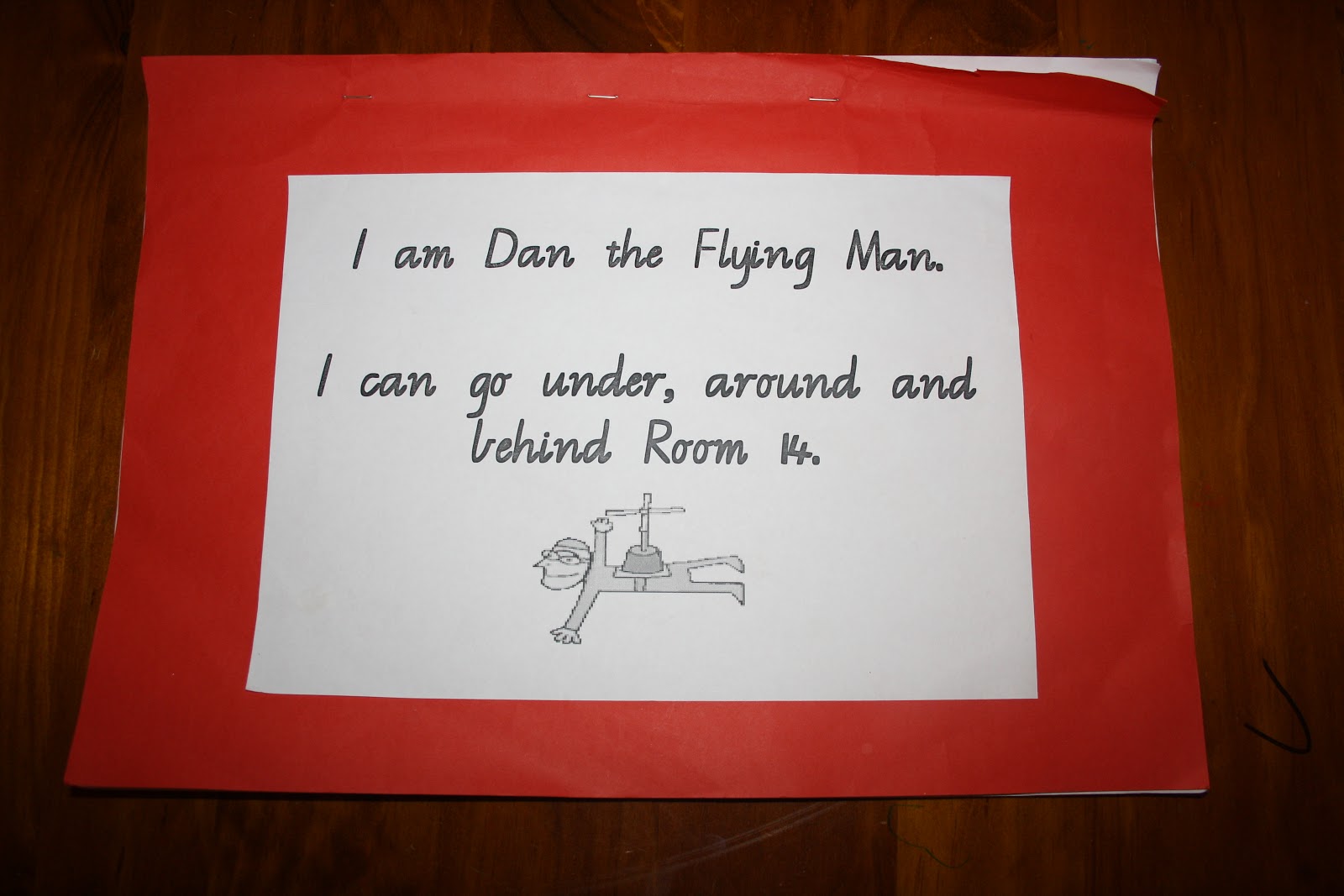
Here are some photos of the class innovated text:


You can enlarge the photos by clicking on them.

Thanks for popping by the WHUB!

If you haven't registered for our Woodlands Australian Curriculum Implementation (WACI) Club for 21 March and would like to - please email Carlene.Thorpe@det.wa.edu.au


Wednesday, 7 March 2012

Pre Primary Lesson

Handa's Surprise
The details of this lesson and the way it links to the Australian Curriculum as are follows:

Learning Area: English
Focus Strand: Language
Focus Sub Strands: Text Structure and Organisation
Content Description: Understand concepts about print and screen, including how books, film and simple digital texts work, and know some features of print, for example directionality (ACELA1433)

Focus Strand: Literature
Focus Sub Strands: Literature and Context
Content Description: Recognise that texts are created by authors who tell stories and share experiences that may be similar or different to students’ own experiences (ACELT1575)
 
Focus Strand: Literature
Focus Sub Strands: Examining Literature
Content Description: Identify some features of texts including events and characters and retell events from a text (ACELT1578)

Focus Strand: Literacy
Focus Sub Strands: Interacting with Others
Content Description: Listen to and respond orally to texts and to the communication of others in informal and structured classroom situations (ACELY1646)


The text is called "Handa's Surprise" by Eileen Browne

Click HERE to download/view the teacher's lesson plan.When you click the link it will open in Goggle Docs. When that screen opens, click on FILE and then DOWLOAD.
Here are some samples of student responses to the text by making text-to-self connections:


If you would like copies of the student sheets please click the photos below and download from Google Docs.


Tuesday, 6 March 2012

"A Surprise for Dingo" - AC: English Year 2 Learning Sequence

 A Surprise for Dingo
The details of this lesson and the way it links to the Australian Curriculum as are follows:

Learning Area: English
Focus Strand: Literature
Focus Sub Strands: Examining Literature
Content Description: Discuss the characters and settings of different texts and explore how language is used to present these features in different ways (ACELT1591)

Focus Strand: Language
Focus Sub Strands: Expressing and Developing Ideas
Content Description: Identify visual representations of characters’ actions, reactions, speech and thought processes in narratives, and consider how these images add to or contradict or multiply the meaning of accompanying words (ACELA1469)

The text is called "A Surprise for Dingo" by Rina A. Foti and Sandra Kendell

Click HERE to download/view the teacher's lesson plan.When you click the link it will open in Goggle Docs. When that screen opens, click on FILE and then DOWLOAD.


Below are photos of some of the whole class discussion sheets. Click the photo to enlarge in another screen.


In the photos above you can see the "maybe" statements first using the clues from the front cover. The next photo is the modelled character analysis.  The cluster of "good" or "bad" event predicitions is the last photo. This was interesting depending on what they thought of the dingo character as to whether it was a good or bad event.

In the lesson plan you will read where students use RoundTable to write what they think the characters might be saying on the front cover. The students enjoyed doing this and they needed to build upon what previous student/s had written so the speech sequence was cohesive. Here is a photo of the students:


This photo shows their team presenting their speech bubbles:


Click HERE to download a copy of the speech bubble sheet if you would like to to this activity. When you click the link it will open in Goggle Docs. When that screen opens, click on FILE and then DOWLOAD.

It is interesting to note that if you read this story with a "bad" character voice for the Dingo up until the "suprise", the students really believe the dingo is a "bad" character. I showed the students how changing my voice changes their idea of what the character is like. They said I "tricked them"! :-)

This series of lessons enabled the teacher to collect Achievement Standard evidence regarding the students ability to identify language features used to describe characters.

Tuesday, 21 February 2012

"Twinkle" AC:English Year 2 Learning Sequence

Twinkle with the Year 2s!

The details of this Literacy lesson and the way it links to the Australian Curriculum as are follows:

Learning Area: English
Focus Strand: Literacy
Focus Sub Strands: Interpreting, Analysing and Evaluating  - Use comprehension strategies to build literal and inferred meaning and begin to analyse texts by drawing on growing knowledge of context, language and visual features and print and multimodal text structures

The text is called "Twinkle" by Nick Bland.

Click HERE to download/view the teacher's lesson plan. 
This photo is the result of class discussion of reasons why the characters are sitting on the roof. Click the photo to see a larger version.
Here are some examples of the titles the students gave the book based upon their discussion of the front cover.  
On a large sheet of paper students looked for clues about how the character might solve the problem presented in the story. Here is a photo:


Prediction anchor chart:


Student work samples of predictions based upon the illustration clues and inferences:


If you would like a copy of the prediction sheet click HERE to download!

Inference of character feelings based upon the text read:


Thursday, 16 February 2012

Year 3 Literature Lesson!

Today our school has a fantastic 
Year 3 Literature Lesson to share with you!

The details of the lesson and the way it links to the Australian Curriculum as are follows:

Learning Area: English
Focus Strand: Literature
Focus Sub Strands:  Literature and Context - Discuss texts in which characters, events and settings are portrayed in different ways, and speculate on the authors' reasons 
                                
                               Responding to Literature - Draw connections between personal experiences and the worlds of texts, and share responses with others 


The text is called "Just Another Ordinary Day" by Rod Clement.

The teacher's lesson plan is below. You can download this lesson plan below:


Further notes on the lesson to support the plan

Session 1:  Teacher reads text to students as a "blind reading" - students hear the text but do not see the illustrations.  Following this, the students are given a blank piece of paper with one section of the text written on the page. The student's are required to illustrate the page to match the text as they see it in their mind, drawing on personal experience. Teacher uses this to create a class book. Teacher shares book with whole class and discusses aspects of illustrations. For example: Why did you do draw it that way? 

Here are some examples of the student's work:


Session 2:  Compare student illustrations to author's illustrations. Here are the two author illustrations for the text that was used above:


PMI as a class regarding the preference between their illustration and the author's. Here is the PMI that was conducted on the Smartboard.


Session 3:  InsideOutsideCircle is a cooperative learning structure. Please see the comprehension cards for this task below by clicking on the link and downloading in Google Docs. 


Session 4:  Students independently answer written comprehension questions regarding the text.   Please see the written component for this task below by clicking on the link and downloading in Google Docs. 


Extension Task:  Make a class version of "Our Ordinary Day". Using First Steps strategy of text innovation, the teacher scaffolded the writing of a class version of the story using student names and the daily schedule of the class as the events in the story. This was undertaken on the Smartboard. Each student was responsible for illustrating their page using a style similar to the author.  This session links further to the English Literature content in the Sub Strand of Creating Literature: Create imaginative texts based on characters, settings and events from students’ own and other cultures using visual features, for example perspective, distance and angle. Here is a sample of student work in relation to this task.  You can see how the student has used the style of the author's illustration.


Teacher reflection:  The activities were creative ways of meeting the content descriptions. A range of achievement levels and understanding was easily viewed.  Following the comprehension task, it was clear the students needed more exposure to inferential questions and answers. The teachers will be targeting character traits in terms of appearance and personality. 

We thank the students for giving us permission to share their work!

Please feel free to use this lesson sequence in your class! We would love to hear how it went!

Wednesday, 8 February 2012

Noggle!

Behold the Wonderment of NOGGLE!

Our Year 3 teacher created a new twist on the letter game Boggle. It is using numbers - hence Noggle!

The students are given a grid such as this:
The rules for Noggle are:

  1. Write all the number sentences you can find using the numbers on the grid.
  2. The boxes that the numbers are in must be touching.
 The students recorded their number sentences using this sheet:


Noggle can be played using the Cooperative Learning structure of RallyCoach.

The Year 3 students are now off to teach Noggle to the class next door! 

Noggle is linked to the following Mathematics Content from The Australian Curriculum:

  • Recognise and explain the connection between addition and subtraction (ACMNA054)
  • Recall addition facts for single digit numbers and related subtraction facts to develop
    increasingly efficient mental strategies for computation (ACMNA055)


Wednesday, 7 December 2011

First Steps Links to Australian Curriculum!

I received a phone call today from Waggrakine Primary School asking for details of how to access the First Steps documents which link the Australian Curriculum in English and Maths to the First Steps Resource books.

Just in case you haven't seen these fantastic documents - Click on the Learning Area name to access the links below...


How will First Steps 2nd Edition English Resources Support the Implementation of the Australian Curriculum: English?
The Australian Curriculum: English includes content descriptions at each year level in the three strands being language, literature and literacy. These describe the knowledge, concepts skills and processes that teachers are expected to teach and students are expected to learn. The Australian Curriculum does not prescribe approaches to teaching.

First Steps 2nd Edition English resources will help teachers make decisions about instruction and appropriate approaches to teaching, including purposeful activities to achieve the learning outlined within all strands of the Australian Curriculum: English. First Steps resources do not stand in place of the curriculum or a set of standards but can be used as a powerful and practical resource in conjunction with the new Australian Curriculum.
The following pages provide an illustration of the broad links between The Australian Curriculum V1.2 and the First Steps resource texts.
This document will provide guidelines of where you will find support information within the First Steps texts for each of the English Content Descriptors. This includes links to the Reading, Writing, Speaking and Listening and Viewing Maps of Development and Resource Books.


How will First Steps 2nd Edition English Resources Support the Implementation of the Australian Curriculum: English?

The Australian Curriculum: English includes content descriptions at each year level in the three strands being language, literature and literacy. These describe the knowledge, concepts skills and processes that teachers are expected to teach and students are expected to learn. The Australian Curriculum does not prescribe approaches to teaching.
First Steps 2nd Edition English resources will help teachers make decisions about instruction and appropriate approaches to teaching, including purposeful activities to achieve the learning outlined within all strands of the Australian Curriculum: English. First Steps resources do not stand in place of the curriculum or a set of standards but can be used as a powerful and practical resource in conjunction with the new Australian Curriculum.
The following pages provide an illustration of the broad links between The Australian Curriculum V1.2 and the First Steps resource texts.
This document will provide guidelines of where you will find support information within the First Steps texts for each of the English Content Descriptors. This includes links to the Reading, Writing, Speaking and Listening and Viewing Maps of Development and Resource Books.


:-) So useful!